Fudō Myōō
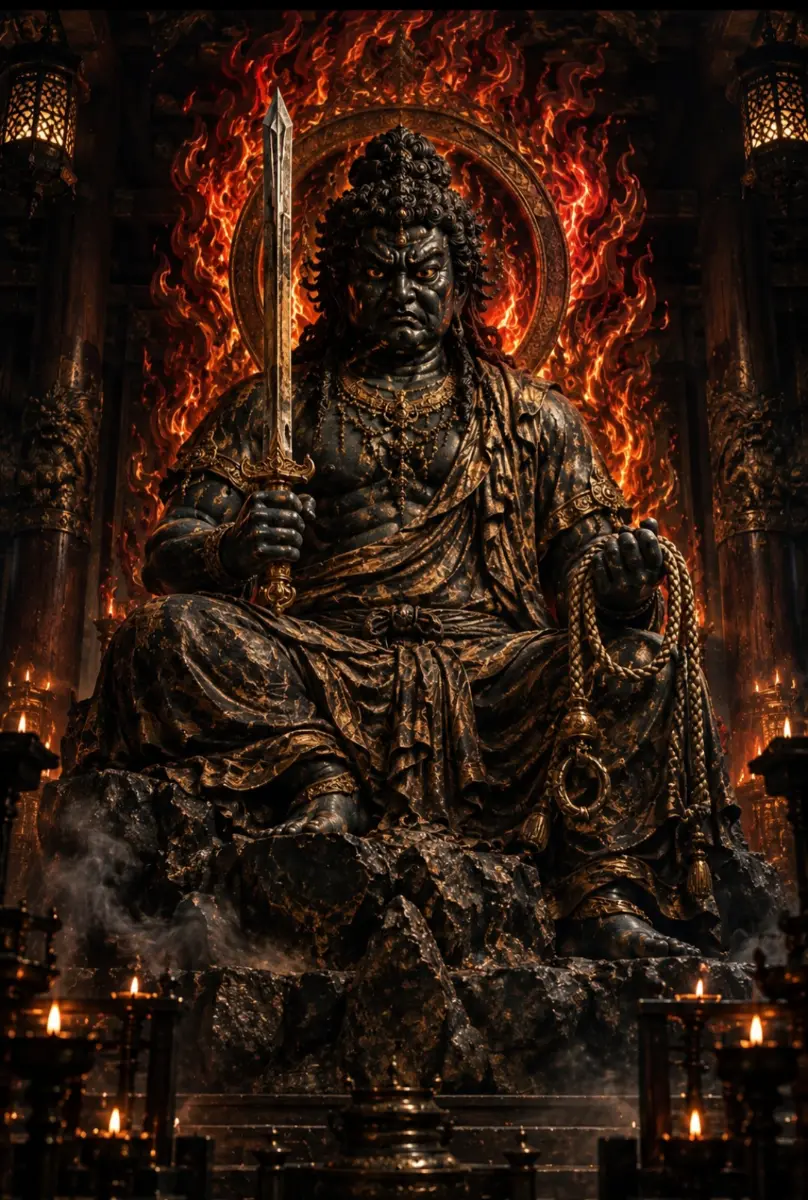
Fudō Myōō — The Immovable Wisdom King
不動明王
Among the formidable figures of Japanese Buddhist tradition, few possess the visual power of Fudō Myōō.
Surrounded by fire, holding a sword in one hand and a rope in the other, his expression is fierce and uncompromising. Yet behind this intimidating appearance lies something considerably deeper than anger or aggression.
Fudō Myōō is the Immovable Wisdom King.
His Japanese name, 不動明王, contains much of his meaning.
Fu — 不 — not.
Dō — 動 — movement.
Together, Fudō conveys the sense of the unmoving or immovable.
Myōō — 明王 — is commonly translated as Wisdom King, one of the powerful protective figures found particularly within Esoteric Buddhist tradition.
Fudō is the Japanese manifestation of Acala, a Buddhist figure whose traditions travelled from India through China and eventually into Japan. In Japanese Esoteric Buddhism, particularly the Shingon and Tendai traditions, Fudō developed into one of the most recognisable and important of the Myōō.
His frightening appearance can easily be misunderstood.
Fudō does not represent uncontrolled rage.
His wrath is purposeful.
It represents an uncompromising determination to destroy ignorance, overcome obstruction and prevent the mind from being carried away by those forces which lead it from clarity.
This is why almost every element of his appearance carries meaning.
The sword cuts through ignorance and delusion.
The rope binds and restrains destructive forces.
The flames consume impurity and obstruction.
The rock upon which he is often depicted represents his unshakeable foundation.
And at the centre of all this apparent violence sits something remarkably still.
Fudō himself.
Fire moves around him.
His expression is ferocious.
His sword is ready.
Yet he remains unmoved.
It is this extraordinary contradiction — fierce yet composed, powerful yet controlled, surrounded by movement yet internally still — that would eventually give the image of Fudō particular resonance within Japan's warrior culture.
For the warrior, immovability did not mean an inability to move.
It meant something considerably more difficult.
The ability to act without first being moved by fear, anger, hesitation or ego.
The Fierce Exterior — The Still Centre
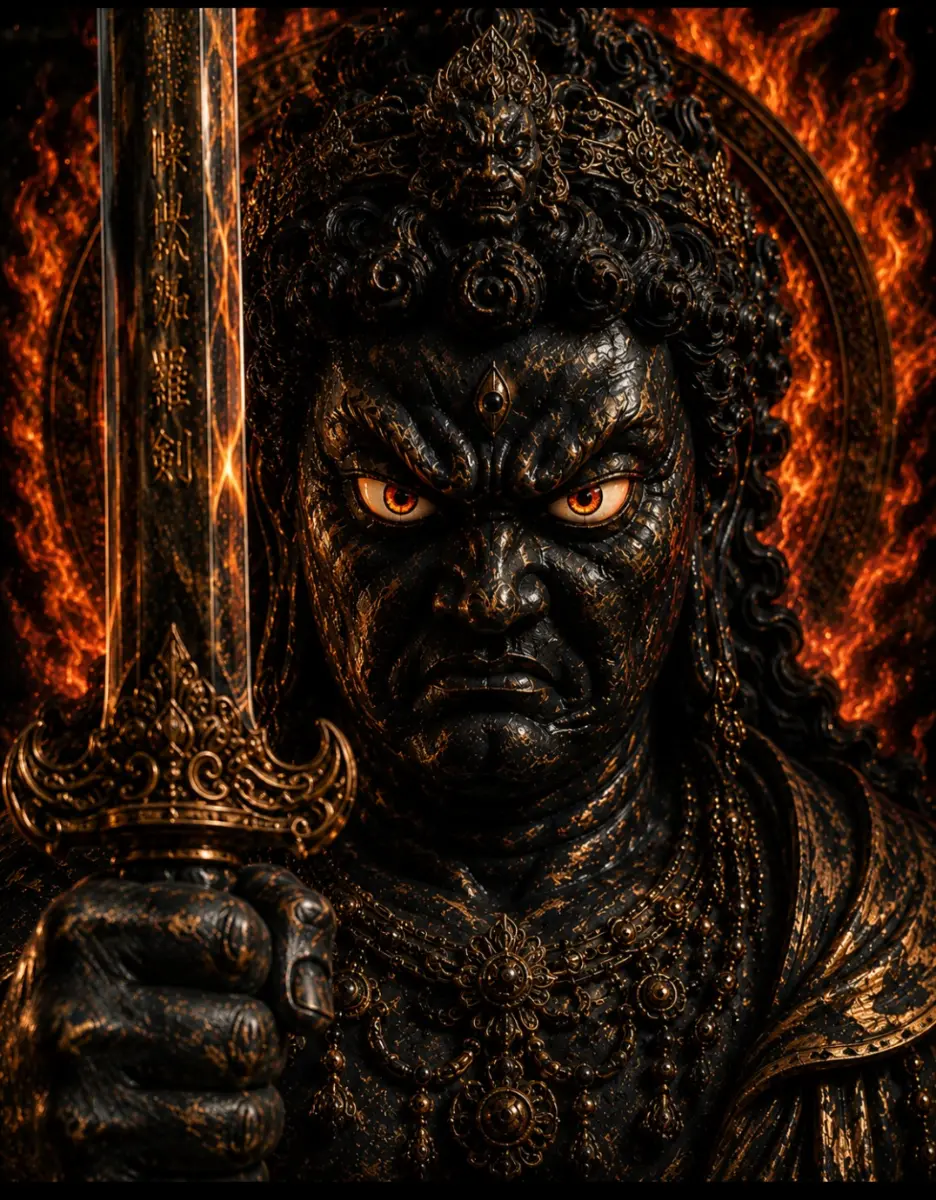
One of the great subtleties of Fudō Myōō lies in the apparent contradiction of his appearance.
He looks furious.
Yet he is not uncontrolled.
He appears threatening.
Yet his purpose is protective.
Flames rage around him.
Yet at his centre he remains completely still.
The distinction is important.
Fierceness is not the same as anger.
Anger can possess a person. It can narrow perception, disturb judgement and provoke unnecessary action.
Fudō represents something different.
His intensity exists without the loss of control.
Nothing in his appearance suggests uncertainty. There is no hesitation and no need for reassurance. His presence is absolute.
For members of Japan's warrior class, this combination possessed an obvious significance.
A warrior could not always control the circumstances surrounding him. He could not determine the actions of an opponent, remove danger from the battlefield or guarantee the outcome of an encounter.
What remained within his influence was his own condition.
Fear might arise.
Danger might be real.
Death might be possible.
But none of these things had to be allowed to take possession of the mind.
This is where the apparent ferocity of Fudō reveals its deeper meaning.
The flames may rage.
The threat may remain.
The world may move.
The centre does not have to move with it.
The Sword of Wisdom
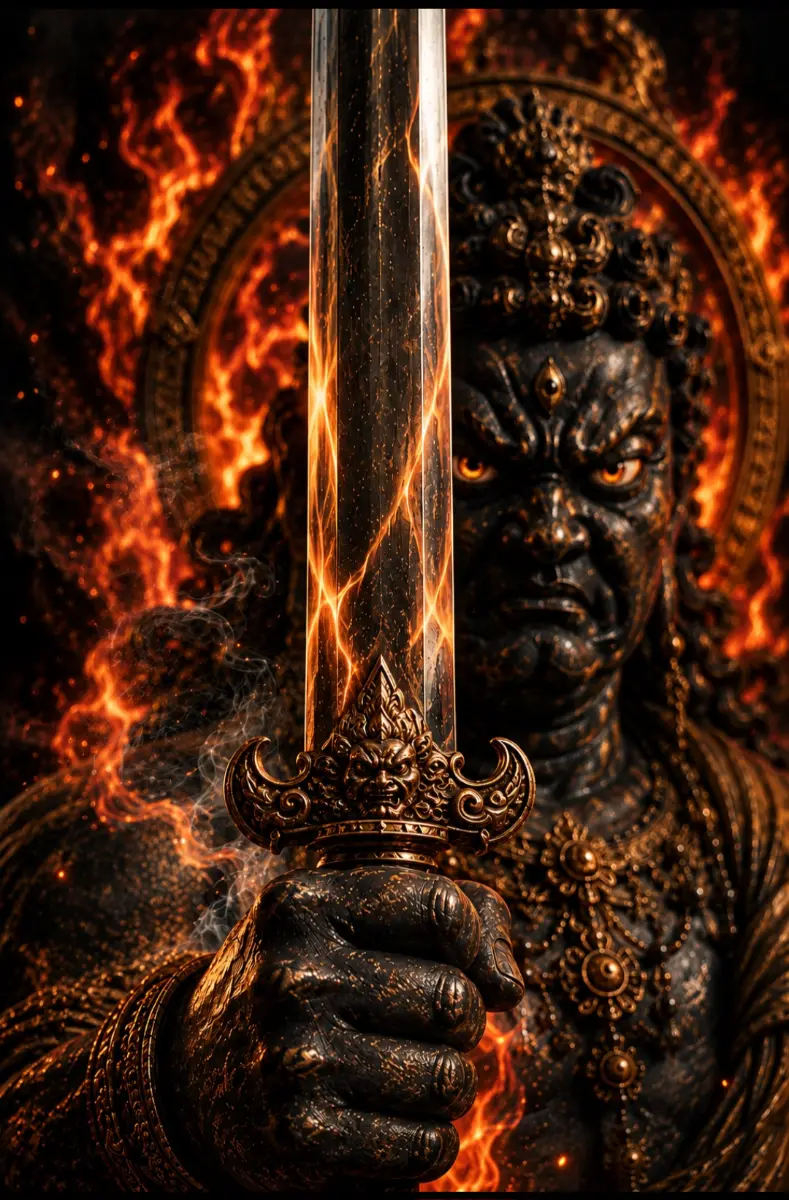
In Fudō Myōō's right hand is one of his most recognisable attributes: the sword.
It would be easy, particularly when viewing Fudō through the eyes of the warrior, to interpret the weapon simply as a symbol of martial power.
Its meaning is considerably deeper.
The sword of Fudō is the sword of wisdom — a weapon directed not merely against an external enemy, but against ignorance, delusion and those things which prevent clear perception.
Its presence alongside Fudō is therefore significant.
A sword divides.
It separates one thing from another.
Symbolically, the sword of wisdom separates what is real from what is imagined, what is necessary from what is unnecessary, and clarity from confusion.
For the martial practitioner, the parallel is difficult to ignore.
Training with the sword begins with learning what to add.
Posture.
Movement.
Distance.
Timing.
Technique.
Control.
But as understanding develops, training increasingly becomes concerned with what can be removed.
Unnecessary tension.
Unnecessary movement.
Hesitation.
Anticipation.
Fear.
The desire to force an outcome.
The need to demonstrate ability.
Eventually, even attachment to technique itself can become an obstruction.
The sword therefore offers an unusual metaphor for martial development.
At first, we learn how to use it to cut.
Later, we begin to understand what needs to be cut away from ourselves.
This does not mean destroying emotion or attempting to become without feeling.
It means recognising what interferes with clear action.
Fear may arise without controlling us.
Thought may arise without trapping us.
An opponent may threaten without possessing our attention completely.
A mistake may occur without remaining in the mind after the moment has passed.
The sword of wisdom represents this ability to distinguish without becoming entangled.
And there is another subtlety.
A sharp sword does not need unnecessary force.
When alignment, angle and movement are correct, the blade performs its function with remarkably little effort.
The same principle can be recognised within the mind.
Confusion creates effort.
Clarity removes it.
The deeper symbolism of Fudō's sword is therefore not simply destruction.
It is discernment.
To cut through illusion.
To remove obstruction.
And ultimately, to see clearly enough that nothing unnecessary remains between intention and action.
The Rope
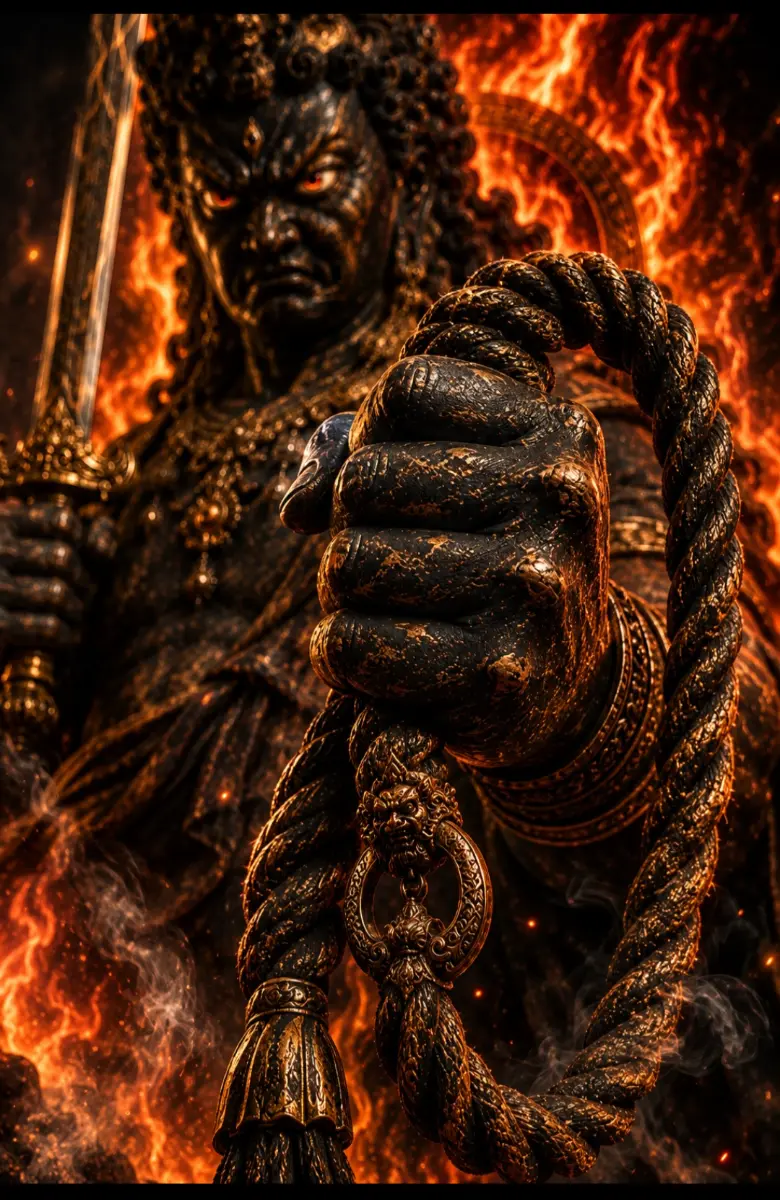
In Fudō Myōō's other hand is a rope — the kensaku, a cord or lasso that forms one of his most recognisable attributes.
Where the sword cuts through ignorance and delusion, the rope serves a different purpose.
It binds and restrains.
Within Buddhist symbolism, Fudō's rope is used to bind those forces that lead beings away from wisdom and to draw them back towards the path. It therefore represents control, restraint and the refusal to allow destructive influences to wander unchecked.
Placed beside the sword, the two objects form an important balance.
Not everything must be cut away.
Some things must be brought under control.
This distinction has particular depth when considered through martial practice.
Fear, anger, pride and uncertainty are natural human responses. Discipline does not necessarily require their destruction. Nor does strength mean becoming incapable of feeling them.
The question is whether they are allowed to govern what happens next.
A person may experience fear and still act with courage.
Anger may arise without being given command of the body.
Pressure may be felt without causing the mind to collapse beneath it.
Pride may appear without preventing correction.
The presence of emotion is not weakness.
Being controlled by it is something different.
In this sense, the rope represents restraint without suppression.
There is no need to pretend that fear does not exist. It is enough that fear does not decide.
There is no need to deny anger. It is enough that anger does not hold the sword.
There is no need to destroy the ego. It is enough to recognise when the ego has begun making decisions on our behalf.
This is one of the quieter lessons contained within the otherwise formidable image of Fudō.
His sword possesses the power to cut.
His rope possesses the power to restrain.
Wisdom lies in knowing which is required.
For the martial practitioner, restraint is not the opposite of strength.
It is one of its clearest demonstrations.
To possess the ability to act and yet remain capable of choosing not to act requires considerably greater control than simply following the first impulse that arises.
The rope therefore represents another form of immovability.
The world may pull.
Emotion may pull.
Fear may pull.
Ego may pull.
But they do not have to move us.
The Flames
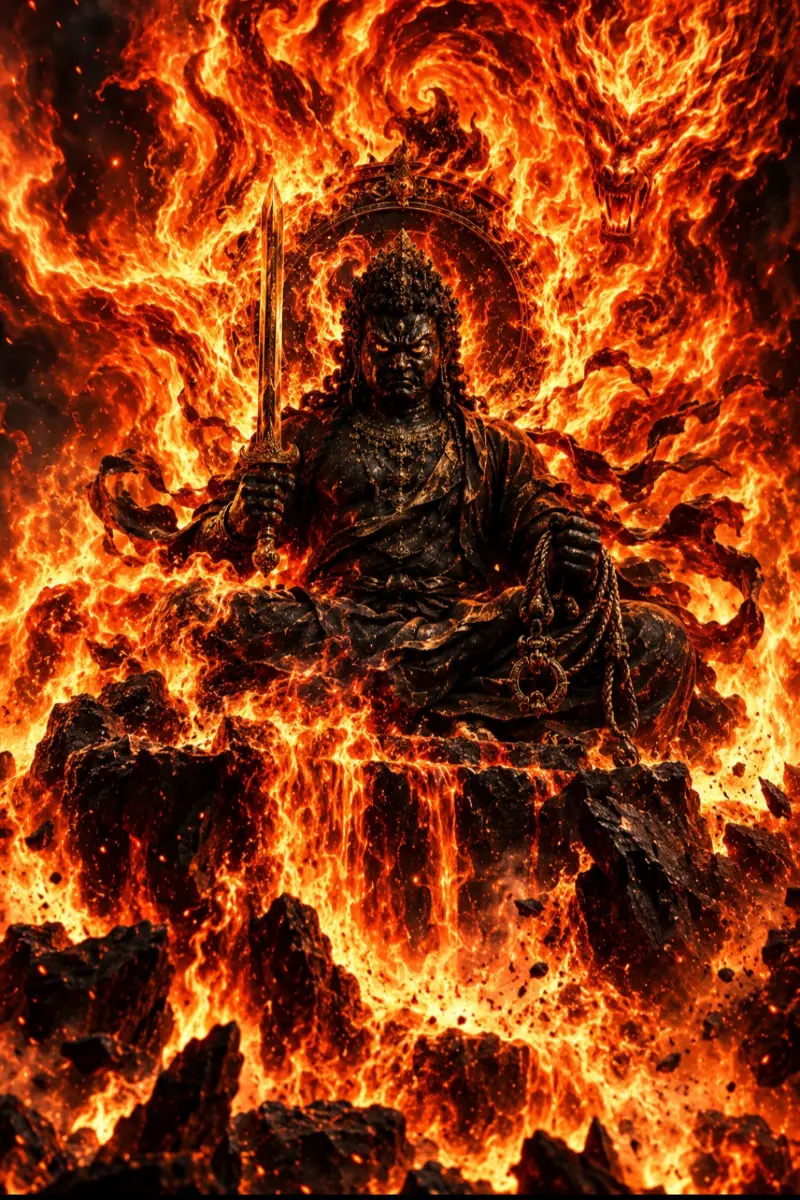
Fudō Myōō is rarely imagined without fire.
Behind him rises a great aureole of flame, surrounding his otherwise immovable form with violent movement.
These are not the flames of uncontrolled anger.
They are the flames of purification.
Within Buddhist symbolism, Fudō's fire consumes ignorance, attachment and the obstacles that prevent awakening. It is a fire that transforms rather than one that burns without purpose.
This distinction is important.
Fudō himself is not consumed by the flames.
He remains within them.
Everything around him appears to move. Fire twists, rises and changes from one moment to the next, while the figure at its centre remains grounded and composed.
It creates one of the most powerful contradictions within his imagery:
the environment is violent; the centre is still.
For the martial practitioner, there is an obvious parallel.
Pressure has a way of revealing what ordinary practice can conceal.
A technique may appear effortless when performed alone.
Breathing may remain calm when nothing threatens it.
Posture may remain correct when there is unlimited time to prepare.
The mind may appear settled when nothing is attempting to disturb it.
Pressure changes this.
An opponent moves unexpectedly.
Distance collapses.
Timing disappears.
Fatigue enters the body.
A mistake occurs.
Suddenly the practitioner discovers which parts of his training are genuinely established and which existed only while circumstances remained comfortable.
In this sense, pressure can become its own kind of fire.
It exposes.
It removes pretence.
It reveals unnecessary tension, hesitation, fear and attachment to a predetermined outcome.
And if the practitioner remains within that pressure rather than continually escaping from it, something begins to change.
Movement becomes simpler.
Breathing becomes quieter.
Reaction becomes observation.
What once created panic becomes information.
The fire has not necessarily become smaller.
The person standing within it has changed.
This is one of the deeper lessons suggested by the image of Fudō.
Immovability is not developed by arranging life so that nothing can disturb us.
It is discovered by encountering disturbance without surrendering ourselves to it.
The flames therefore do not diminish Fudō's stillness.
They reveal it.
Without movement around him, there would be no demonstration of immovability.
Without pressure, composure remains largely untested.
Without difficulty, discipline can remain theoretical.
The fire gives the stillness meaning.
And perhaps that is why the image remains so powerful.
Fudō does not wait for the flames to disappear.
He sits among them.
The Rock
Immovable Does Not Mean Motionless
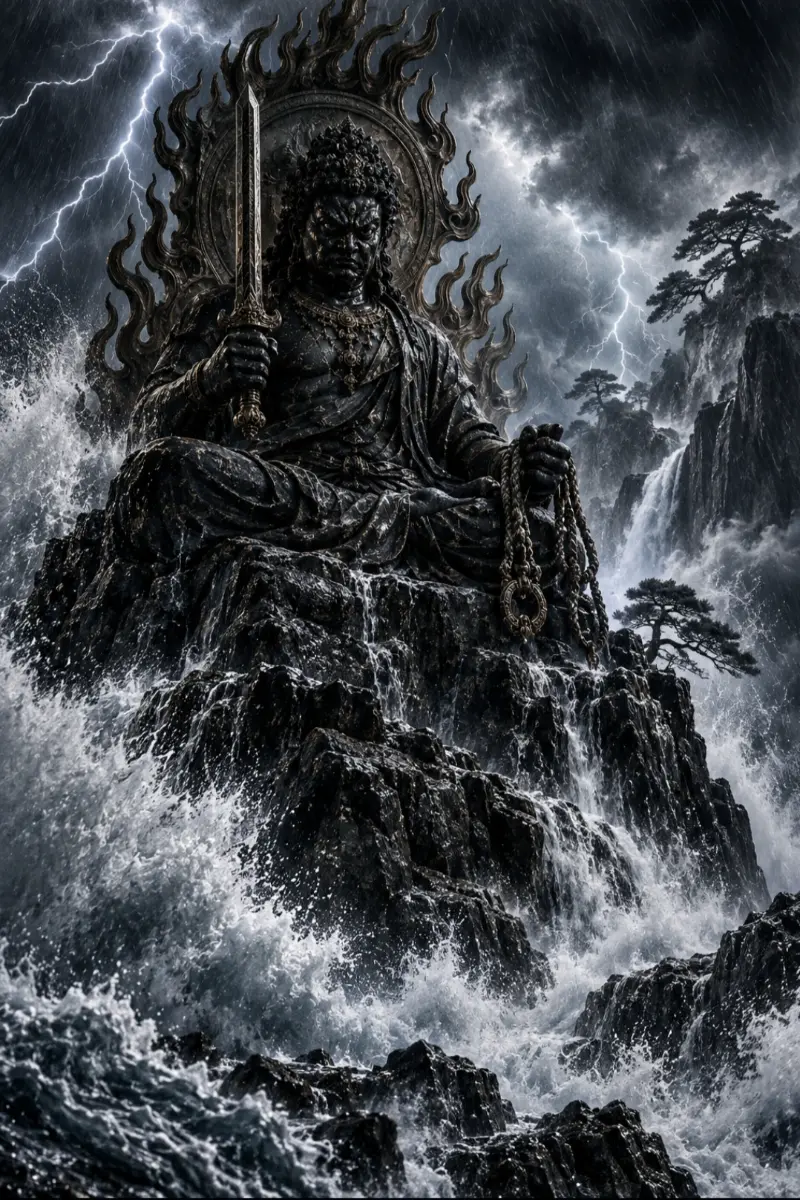
Fudō Myōō is frequently depicted seated or standing upon rock.
Against the violence of the flames surrounding him, the symbolism is unmistakable.
The fire moves.
The rock remains.
Yet the meaning of immovability should not be confused with rigidity.
Something rigid may resist change, but rigidity can also make something fragile. Under sufficient pressure, that which refuses to yield may eventually break.
Fudō's immovability represents something deeper.
It is not an inability to move.
It is the ability to move without losing the foundation from which movement arises.
For the martial practitioner, this distinction is fundamental.
Distance changes.
Timing changes.
The opponent changes.
Terrain changes.
Balance changes.
What was correct a moment ago may no longer be correct now.
The practitioner who becomes attached to a predetermined response is not immovable.
He is trapped.
True stability must therefore contain adaptability.
The feet may move.
The body may turn.
The sword may change direction.
The distance may close or open.
Strategy may change completely.
Yet beneath all of this movement something remains undisturbed.
The centre.
This is why stillness within martial practice should never be mistaken for inactivity.
A person standing completely motionless may be mentally chaotic.
Another may be moving rapidly while remaining internally composed.
The outward appearance tells us very little about the condition within.
The deeper principle is not:
Do not move.
It is:
Do not be moved unnecessarily.
That difference changes everything.
An opponent may cause us to move physically without moving us mentally.
Pressure may require adaptation without creating panic.
A failed technique may require immediate change without creating frustration.
An unexpected attack may alter everything externally while changing nothing essential internally.
The practitioner remains available to what is actually happening rather than becoming attached to what he expected to happen.
This is the paradox contained within Fudō.
Immovability creates freedom.
Because the centre is not easily disturbed, everything around it is free to adapt.
The rock therefore represents more than strength.
It represents foundation.
Not the stubbornness to resist every force.
Not the rigidity to remain exactly where we began.
But something far more useful:
the ability to change without losing ourselves.
The flames move.
The world moves.
The opponent moves.
We move.
The centre remains.
Fudō Myōō and the Samurai
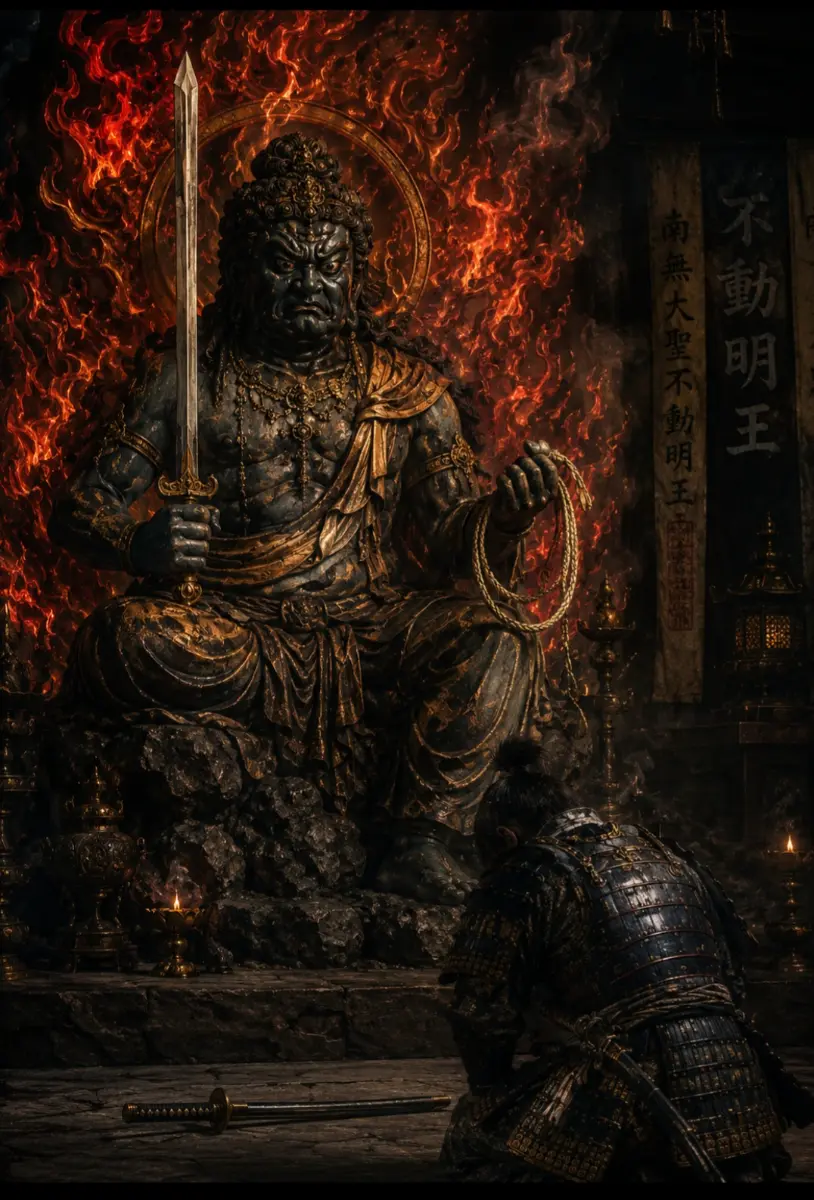
The formidable appearance of Fudō Myōō found a particular resonance among Japan's warrior class.
This was more than a later romantic association.
Images of Fudō were commissioned by warriors, incorporated into objects associated with the warrior culture, and carried meanings that were particularly relevant to men whose lives could depend upon their ability to remain composed in circumstances of extreme danger.
The attraction is not difficult to understand.
Fudō presented the warrior with an extraordinary image:
ferocity without loss of control.
His expression is wrathful, yet his purpose is not uncontrolled anger.
He carries a weapon, yet the sword represents wisdom.
He possesses the power to bind, yet restraint remains part of his strength.
Fire surrounds him, yet he is not consumed by it.
Everything about Fudō communicates intensity.
Everything at his centre communicates control.
For a warrior, these qualities possessed obvious significance.
Technical ability alone could never guarantee survival.
A swordsman might possess considerable skill and still be defeated if fear caused hesitation.
Anger could encourage reckless movement.
Pride could make retreat impossible when retreat was necessary.
An eagerness to attack could reveal intention too early.
Attachment to a particular technique could prevent adaptation when circumstances changed.
The battlefield therefore presented more than a physical problem.
It presented a problem of mind.
The warrior had to function while surrounded by uncertainty.
He could not demand that danger disappear before becoming composed.
He could not wait until fear had gone before acting.
He could not rely upon circumstances unfolding as expected.
The condition represented by Fudō offered a powerful ideal:
to remain internally undisturbed while being completely capable of decisive action.
This did not mean becoming emotionless.
Nor did it mean becoming passive.
Fudō is anything but passive.
His imagery suggests tremendous potential for action, yet that potential is governed rather than uncontrolled.
For the warrior, this distinction between intensity and aggression was profound.
Aggression can be provoked.
Intensity can remain.
Anger can be manipulated.
Composure is considerably harder for an opponent to control.
A man who requires anger in order to fight can potentially be drawn into anger.
A man who requires confidence can potentially be made uncertain.
A man who requires circumstances to unfold according to expectation can be disrupted when they do not.
But the warrior who can remain present regardless of what appears before him presents a different problem.
There is less for the opponent to manipulate.
This is where the symbolism of Fudō begins to move beyond religious imagery and towards the deeper psychology of the warrior.
The greatest strength is not always the ability to overpower another person.
Sometimes it is the refusal to allow another person to determine the condition of your own mind.
The opponent may threaten.
He may advance.
He may attempt to intimidate.
He may attempt to provoke.
He may attempt to create hesitation.
Yet none of these things necessarily require an internal response.
The warrior can observe them without becoming possessed by them.
And from that stillness, he remains capable of movement.
The opponent moves.
The danger moves.
The circumstances move.
The mind remains available.
The Warrior Mind
The warrior's greatest difficulty was never simply learning how to use a weapon.
Technique could be practised.
Strength could be developed.
Distance and timing could be studied.
But none of these guaranteed that the mind would remain dependable when the moment became real.
Under genuine threat, the body changes.
Breathing shortens.
Muscles tighten.
Attention narrows.
Time can appear to accelerate or slow.
The mind begins attempting to predict what will happen next.
And perhaps most dangerously, it begins to attach itself.
To the opponent's sword.
To his eyes.
To the possibility of being struck.
To an opening.
To the desire to attack.
To fear.
To victory.
To survival.
Once the mind becomes fixed upon one thing, everything else begins to disappear.
For the swordsman, this presents an obvious danger.
A sword does not exist independently of the person holding it.
The hands move because the body moves.
The body moves because intention moves.
If attention becomes trapped upon the blade alone, the practitioner may see the weapon while failing to perceive the person directing it.
Likewise, if the mind becomes consumed by the desire to attack, it may cease to perceive the changing circumstances that make the intended attack inappropriate.
The problem therefore is not thought itself.
The problem is stopping.
A mind that stops upon fear becomes fear.
A mind that stops upon anger becomes anger.
A mind that stops upon technique becomes imprisoned by technique.
A mind that stops upon victory may already have ceased observing the opponent standing before it.
The cultivated warrior mind therefore does not attempt to become empty by becoming unconscious or indifferent.
Quite the opposite.
It becomes more available.
It sees without becoming trapped by what it sees.
It feels pressure without becoming possessed by pressure.
It recognises opportunity without becoming greedy for it.
It experiences fear without allowing fear to dictate the next movement.
This creates an apparent contradiction.
The mind becomes difficult to move precisely because it is free to move everywhere.
Nothing holds it.
Nothing captures it.
Nothing causes it to remain where the previous moment occurred.
This is why the idea of immovability within martial thought is considerably more sophisticated than stubbornness or emotional hardness.
The warrior is not attempting to become a stone.
He is attempting to become something far more difficult to disturb:
a mind that cannot easily be captured.
And here the image of Fudō begins to reveal another layer.
The flames move.
The sword can move.
The rope can bind.
The body can act.
Yet the mind does not become imprisoned by any of them.
This is the threshold between Fudō, the Immovable One, and the martial idea of Fudōshin — the Immovable Mind.
And to understand that paradox properly, we have to encounter one of the most important figures in the history of Japanese martial thought:
Takuan Sōhō.
Fudōshin — The Immovable Mind
不動心
The principle of Fudōshin — commonly translated as the Immovable Mind — takes the idea embodied by Fudō Myōō and leads us towards one of the deepest concepts within Japanese martial thought.
At first, the term can appear contradictory.
A warrior whose mind cannot move might sound slow, rigid or unresponsive.
Fudōshin means almost the opposite.
The mind is immovable because nothing is permitted to hold it in one place.
An opponent raises his sword.
The mind recognises the sword, but does not remain upon it.
An opening appears.
The mind recognises the opening, but does not become greedy for it.
Fear arises.
The mind recognises the fear, but does not become fear.
A technique fails.
The mind does not remain with the failure.
The moment has already changed.
So must the response.
This is why Fudōshin should never be confused with stubbornness.
Stubbornness refuses to move.
Fudōshin remains free to move.
The distinction is profound.
A swordsman who has already decided what he intends to do may appear confident, but his certainty can become a weakness. If circumstances change and his mind remains attached to the original intention, he is no longer responding to the encounter before him.
He is responding to an encounter that exists only in his imagination.
The immovable mind carries no such obligation.
It observes what is present.
It changes when change is necessary.
It acts when action is necessary.
And when the moment has passed, it does not remain behind.
There is therefore a strange relationship between stillness and freedom.
The less the mind clings to any single thing, the more completely it becomes available to everything.
This does not require the absence of thought.
Nor does it require the destruction of emotion.
The warrior may still experience fear.
He may recognise danger.
He may feel pressure.
He may even become aware of his own uncertainty.
Fudōshin does not demand that these things disappear.
It asks something considerably harder:
Can they arise without taking possession of the mind?
This has an immediate consequence in combat.
The opponent is no longer simply attempting to move the body.
He is attempting, consciously or otherwise, to move the mind.
A feint attempts to capture attention.
Pressure attempts to create hesitation.
Aggression attempts to provoke fear or anger.
An apparent opening attempts to create desire.
Even stillness can be used to create uncertainty.
The moment the mind becomes caught by one of these things, the opponent has achieved something before physical contact has occurred.
He has influenced the conditions under which the next decision will be made.
Fudōshin represents resistance to that capture.
Not resistance through force.
Not resistance through emotional hardness.
But through non-attachment.
The threat is seen.
The pressure is felt.
The opponent is observed.
Yet the mind remains available.
This is why the image of Fudō Myōō is so appropriate.
Around him there is extraordinary violence.
Flames rise.
His sword stands ready.
His expression is fierce.
Everything suggests tremendous potential for action.
Yet at the centre of it all there is no confusion.
He is not empty because nothing is happening.
He is empty because nothing owns him.
And from that condition, movement remains possible in every direction.
This is the deeper paradox of Fudōshin:
The mind that cannot be moved is the mind that is free to move anywhere.
Takuan Sōhō and the Unfettered Mind
To understand the idea of the immovable mind more deeply, we encounter one of the most important figures in Japanese martial philosophy: Takuan Sōhō (1573–1645).
Takuan was a Zen Buddhist monk whose writings became closely associated with the psychological problems faced by the swordsman.
Among the works traditionally connected with him is the Fudōchi Shinmyōroku — often translated as The Mysterious Record of Immovable Wisdom — addressed to the swordsman Yagyū Munenori, one of the most influential martial figures of the early Edo period.
At the centre of Takuan's teaching lies a deceptively simple problem.
Where does the mind stop?
Imagine an opponent raising a sword.
If the mind stops at the sword, attention becomes captured by the weapon.
If it stops upon the opponent's hands, awareness becomes confined to the hands.
If it stops upon the possibility of being struck, fear begins to occupy the mind.
If it stops upon the thought of counterattacking, the intended response itself becomes another form of attachment.
Even one's own technique can become a place where the mind stops.
This does not mean that the sword should not be seen.
It must be seen.
The opponent must be seen.
Distance must be recognised.
Movement must be perceived.
Danger must be understood.
The problem begins when awareness arrives somewhere and remains there.
Takuan's immovable wisdom is therefore built upon a remarkable paradox.
The mind becomes immovable not by fixing itself firmly in one place, but by refusing to become fixed anywhere.
It passes freely through the situation.
It does not linger upon the sword.
It does not remain with fear.
It does not become imprisoned by an opening.
It does not congratulate itself for a successful movement.
Nor does it remain behind with a mistake.
Each thing is recognised and released.
The mind continues.
This is why the expression unfettered mind is so appropriate.
A fetter is something that binds.
The moment the mind becomes attached to one particular thought, object or intention, its freedom begins to diminish.
For the swordsman, that loss of freedom may last only an instant.
But an instant may be enough.
There is also something important here that can easily be misunderstood.
An unfettered mind is not a careless mind.
It is not distracted.
It is not vacant.
And it is certainly not unaware.
Quite the opposite.
Because the mind is not imprisoned by one thing, it remains available to everything.
The opponent's sword is seen without excluding his body.
His body is seen without excluding the distance.
The distance is understood without excluding the surroundings.
An opening is recognised without creating desperation to take it.
Awareness remains broad because nothing has been allowed to possess it completely.
This changes our understanding of stillness.
Stillness does not mean that nothing occurs within the mind.
It means that nothing remains there unnecessarily.
Thought arises and passes.
Fear arises and passes.
Opportunity arises and passes.
Movement arises and passes.
The mind does not need to chase any of them.
Nor does it need to hold them.
In this sense, Takuan's teaching brings us remarkably close to the symbolism of Fudō Myōō.
Fudō is called the Immovable One.
Yet his immovability is surrounded by movement.
Takuan describes a mind that does not stop.
Yet precisely because it does not stop, it becomes extraordinarily difficult to disturb.
These are not opposites.
They point towards the same paradox.
The mind becomes immovable when there is nowhere within it for anything to remain fixed.
The sword may enter awareness.
Fear may enter awareness.
The opponent may enter awareness.
But none are given permanent residence.
They arrive.
They are recognised.
And they are released.
What remains is not emptiness in the sense of absence.
It is availability.
The ability to meet the next moment without still being held by the one that came before.
Intent Without Anger — Pressure Without Force
One of the most striking qualities represented by Fudō Myōō is the separation between intensity and anger.
His appearance is fierce.
His intention appears absolute.
Yet nothing about him suggests that he has lost control.
This distinction has considerable relevance within martial practice.
Anger can create intensity, but it can also create blindness.
It narrows attention.
It encourages unnecessary commitment.
It can make retreat feel like weakness and patience feel like hesitation.
Most importantly, anger makes the practitioner easier to influence.
If an opponent can provoke anger, he has already altered the condition of the mind.
The same is true of fear.
The same is true of impatience.
The same is true of the desire to prove something.
The strongest intention therefore does not necessarily come from the strongest emotion.
It can arise from something much quieter.
Clarity.
The practitioner knows the distance.
He understands the threat.
He recognises what is changing.
And when movement becomes necessary, he moves without requiring anger to carry him forward.
This brings us towards another important concept within Japanese martial practice:
Seme — 攻め.
Seme is often encountered in arts such as kendō and Japanese swordsmanship and can broadly be understood as pressure, attack, or the act of pressing an opponent.
But pressure does not necessarily mean charging forward.
A practitioner can apply pressure through distance.
Through posture.
Through the centre line.
Through timing.
Through the threat of attack.
Through a controlled advance.
And sometimes simply through the unmistakable impression that he is completely prepared to act.
Good seme creates a problem for the opponent.
Move forward, and something may be waiting.
Remain still, and the distance may continue to disappear.
Attack too early, and the attack may be anticipated.
Wait too long, and initiative may already have been lost.
The pressure begins to influence decision.
This is why seme can exist before a strike has occurred.
The swords may not yet have crossed.
Nothing dramatic may be visible.
Yet an encounter has already begun.
Each practitioner is reading the other.
Distance is being negotiated.
Intent is being concealed or revealed.
Openings are being offered, removed or created.
One person may begin to feel compelled to act.
And that is significant.
Because the moment an opponent can be made to act because he feels he must, his freedom has already begun to diminish.
This should not be confused with some mysterious force projected towards another person.
There is nothing supernatural required.
Pressure can arise from entirely practical things: position, timing, posture, movement, distance, confidence, threat and the opponent's perception of what may happen next.
A small movement forward can sometimes create more pressure than a large attack.
A slight change in the sword can alter the opponent's options.
Removing an apparent opening may cause hesitation.
Presenting an apparent opening may invite movement.
Even complete stillness can become pressure when the person standing within it appears ready to respond.
Here we find another interesting connection with the principle of the immovable mind.
The practitioner attempts to influence the opponent without allowing the opponent to influence him unnecessarily in return.
He applies pressure without becoming consumed by the desire to attack.
He threatens without becoming emotionally committed to the threat.
He may invite a reaction without becoming attached to receiving the reaction he expected.
If the opponent responds differently, the mind remains free.
This is where seme and Fudōshin can complement one another conceptually.
Seme attempts to create movement in the opponent.
Fudōshin prevents unnecessary movement within ourselves.
One creates pressure.
The other preserves freedom beneath pressure.
Yet neither requires anger.
This is perhaps one of the most useful distinctions for the martial practitioner.
Intent does not require hostility.
A sword can be raised without hatred.
Pressure can be applied without rage.
An opponent can be confronted without the mind becoming emotionally entangled with him.
Indeed, the absence of anger may make intention considerably more difficult to disturb.
Anger wants something.
Fear wants something.
Ego wants something.
Each creates an attachment to a particular outcome.
Clear intention requires considerably less.
It simply responds to what is necessary.
This brings us back once again to the fierce expression of Fudō Myōō.
His face should not be mistaken for emotional chaos.
The deeper symbolism is almost the reverse.
There is tremendous intensity.
There is unmistakable purpose.
There is the capacity for immediate action.
But beneath all of it remains the same immovable centre.
The strongest presence in an encounter may not belong to the person displaying the most aggression.
It may belong to the person who needs it least.
The Deeper Meaning of Immovability
To be immovable is not to become impossible to affect.
That would be neither realistic nor desirable.
We are affected by the world constantly.
We feel fear.
We experience uncertainty.
We become tired.
We make mistakes.
Other people challenge us, disappoint us, provoke us and sometimes surprise us.
The martial practitioner is not somehow removed from these things.
The deeper meaning of immovability lies elsewhere.
It lies in the space between what happens to us and what we allow it to become.
An opponent may create pressure.
That does not mean pressure must become panic.
An insult may provoke anger.
That does not mean anger must determine our response.
A mistake may create disappointment.
That does not mean disappointment must follow us into the next movement.
Fear may arise.
That does not mean fear must be given authority.
This is perhaps the most difficult aspect of Fudō's symbolism.
The opponent we struggle to prevent from moving us is not always the person standing in front of us.
Sometimes it is ourselves.
Our expectations.
Our pride.
Our fear of failure.
Our desire for recognition.
Our attachment to being correct.
Our need for events to unfold according to the picture we had already created within the mind.
These things can move us considerably further than any physical opponent.
They can cause us to attack when patience would have been wiser.
To hesitate when action was required.
To defend an error because admitting it would injure the ego.
To continue with a technique simply because we had already committed ourselves to it.
To see what we wanted to see rather than what was actually happening.
The deeper practice of immovability therefore becomes a practice of remaining available to reality.
Not the reality we hoped for.
Not the reality we feared.
Not the reality we predicted.
The reality that exists now.
This is where many of the ideas surrounding Fudō Myōō begin to meet.
The sword cuts through illusion.
The rope restrains what would otherwise control us.
The flames expose what pressure reveals.
The rock provides foundation without demanding rigidity.
Fudōshin allows the mind to remain free rather than becoming trapped.
Takuan reminds us that the mind becomes immovable precisely because it does not stop anywhere.
And pressure teaches us whether any of this exists beyond words.
Together they reveal something much more subtle than simple toughness.
Immovability is not resistance to change.
It is freedom from unnecessary disturbance.
A practitioner may change direction instantly and remain immovable.
He may abandon a technique and remain immovable.
He may retreat and remain immovable.
He may recognise that he was wrong and remain immovable.
He may experience fear and remain immovable.
Because the thing that remains is not a particular position, opinion, technique or emotion.
It is clarity.
This gives Fudō's fierce appearance an entirely different meaning.
His strength is not demonstrated by pretending that the flames do not exist.
They surround him.
His strength is not demonstrated by removing every threat.
His sword remains ready.
His strength is not demonstrated by becoming incapable of emotion.
His expression contains tremendous intensity.
And yet none of these things disturb the foundation beneath him.
Perhaps this is why the image has endured for so long.
It presents something recognisable far beyond the circumstances in which it first developed.
Every life contains its own flames.
Every person encounters pressure.
Every mind becomes caught.
The practice is not to construct a world in which nothing can move us.
Such a world does not exist.
The practice is to recognise when we have been moved unnecessarily — and to return.
Again.
And again.
Until returning requires less effort.
Until disturbance leaves less behind.
Until the mind no longer needs perfect circumstances in order to remain clear.
The flames do not have to disappear.
The opponent does not have to become weaker.
The world does not have to become still.
The centre remains.